December 2004: An Earthquake rocked the Sumatra Islands in Bay of Bengal triggering a tsunami across the shores of India. A mass devastation. But in the middle of the devastation of Cuddalore district in South Tamilnadu stood a village, still….. There was a complete protection from the huge waves.. Thanks to Mangroves!
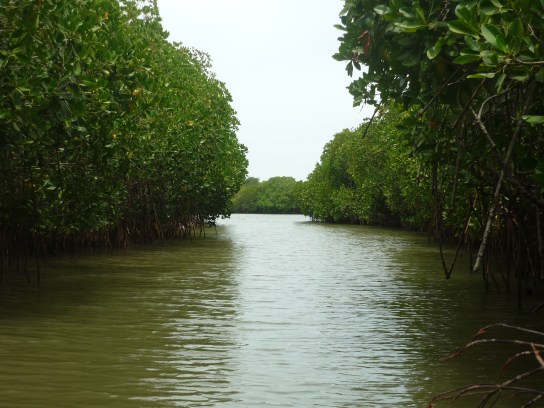
Mangroves: the name immediately brings to our mind the images of the ones at Sunderbans in the East and the home of the Royal Bengal Tiger. But these unknown, small mangrove stretch is present in our own Cuddalore District, attracting tourists and photographic enthusiasts from far and near. Welcome to Pichavaram!!
The Word Mangroves has nothing to do with the king of the fruits- Mangoes though the name might have a similar pronounciation. These are shrubs that grow in the Saline water in dense growth on the various islands present in the backwaters of the estuary meeting the sea. The Vellar Estuary and the Coleroon estuaries in the Bay of bengal forms the base for these Mangroves
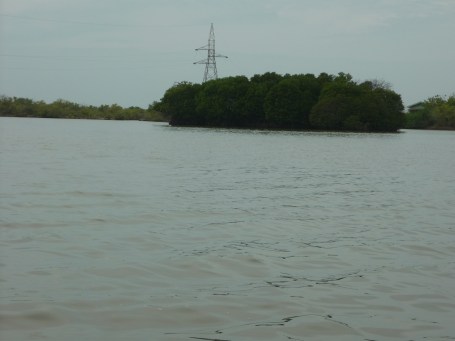
As we step into one of the boats operated by the TTDC (Tamilnadu Tourism Corporation) we are greeted by a vast area of emptiness. The estuaries are huge and we feel as if the Mangroves are dotting the edges of the water. The saline water and the humid sun gives a feeling of what we are going to encounter the next 2 hours
As the boat proceeds, we are greeted by the various fisherman boats that dot the area. Known as a fishing village, the estuary provides a major means of livelihood for the fishermen of the area . The fishes give us company alongside the boat as we proceed
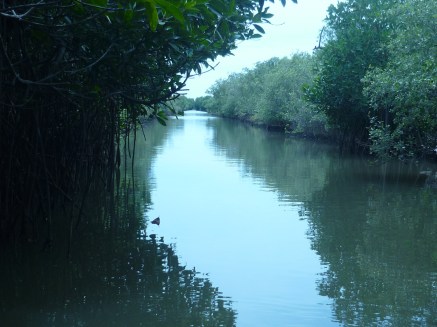
As the boat ride ventures further away from the sea shore, almost parallel to the coast and perpendicular to the water flow, we reach close to examining the mangroves in detail. They are a bunch of shrubs collectively staying together. Well -“Unity is Strength “and this togetherness with the deep rooted roots into the saline water is what saved the massive tides from targeting this place
The boatman slowly moves the boat and we venture far away from our point of boarding the boat. The point is lost in sight. The sun is directly overhead at noon. We lose track of directions. The water stands still near the mangroves responding only through ripples of the oar of our boat
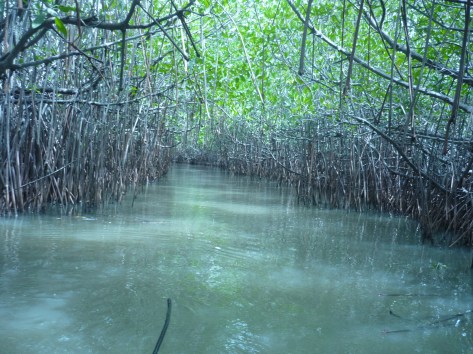
We proceed further into the channels formed by the mangroves. This is where major birds too reside as it protects them from predators giving a upper cover. An ocassional kingifhser gives us company flying with the boat rhythm. The shrubs voer us over. The branches that seemed small and thin now touch us with full force giving a small jolt. The roots of the shrubs are dotted with shells. “Crabs stay inside them” says the boatman warning us not to by any chance put the hand in water in these places. “The shells have sharp edges enough to slice your hand” he says. Red crabs move about slowly on the roots in search of their lunch. Reminds us too that lunch time is nearing
The islands are filled with fauna like Fox and crab eating otters. We are prohibited from keeping our legs to descend to the islands lest the shells hurt us or the animals find us or worst we lose ourselves We are asked just to stay still
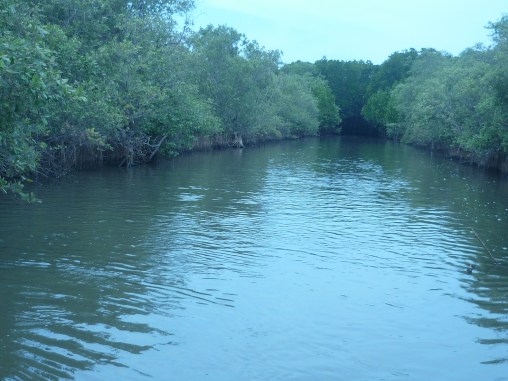
As we venture through one channel to another, the boatman jokingly asks us to tell the route back. We just smiled. In Tamil movie Idhayakani, the hero is brought blindfolded kidnapped by the villains, and the scene was shot in this area. But why was the hero blinfolded. Even if his eyes would have been open, only the villain could have taken him out from here
In “Thottu Muzhangidum nayanam ketkudhu” song from Chinnavar, the scenes are shown from this particular location, including through one of the small channels. More than the hero heroine, the team should have taken extra care from the hanging branches of the Mangroves while shooting here
As we complete our 2 hour round and return to base, it was amazing how the 2 hours had passed. The boatman also tells about a ride available to the beach at the end of the stuary, but can be undertaken only when the tide is good. Low tide will make it tough to get to the beach and the journey would take 5 hours. “Even in the normal boating, there are about 200+ routes”, says the boatman.. “Well each route would be a different waterscape, thought myself”..We finish our trip exhausted but happy at the peaceful calmness the area provides 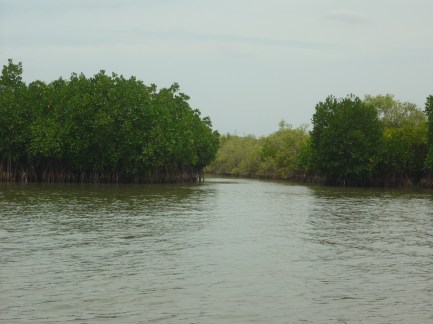
Charges:
2-3 boating options available with minimum being an hours ride charging about Rs.100/- a head and the highest being the visit to the beach charging about Rs.600/- including a rest at the beach. Whole day is required for the beach package and hence kindly plan accordingly
Boating starts by about 8:30AM in the morning and ticket issue closes by around 4PM in the evening. Owing to fishing activities and to prevent other issues, night boating is not allowed in the area
Location & How to Reach
Pichavaram Mangroves are located about 7 kms from the town of Chidambaram in Tamilnadu, South India. Chidambaram is the nearest Railhead and a major bus stand for TNSTC buses operated by the State Government
Buses are not regularly available to Pichavaram and hiring a rental cab or auto would be a better choice to reach this place from Chidambaram. Chidambaram is well connected by trains from Chennai Egmore and Trichy on the Mainline and buses from all over Tamilnadu as well as from Bangalore. Chidambaram also has weekly connections with Mumbai (11017/18), Bhubaneshwar (18495/96), Varanasi (15119/20). Mayiladuthurai, located 40 kms from Chidambaram has daily train service to Bangalore, Mysore and Coimbatore
Accommodation and Food
Accommodation facilities are available in the Town of Chidambaram. Food has to be packed at Chidambaram or planned in such a way to finish off or take the same at Chidambaram.
When to visit
Being an estuary with waters from the Bay , water is always present. Best to avoid summer and warm seasons as sitting in the boat will be very tough. Post monsoons is the best season for visiting. Kindly ensure to carry caps and enough liquids as the place will always be humid owing to the presence of the saline water. Carry a pair of binoculars if possible

 South India- The Splendour!!
Superb…beautiful way to see things positively.
LikeLiked by 1 person
Hi Siddarth, We expect more of these. A small section on the other nearby tourist spots will be more useful.
LikeLiked by 1 person
Thank you..
If I had written about Chidambaram, I could have put this as a nearby spot. But in this case its exactly the opposite
When I write about Chidambaram, will include this link
Thank you for the suggestion
LikeLike