India is a land of diversity. Diversity , exists not only demographically, but also geographically a, historically naturally, mythologically and geologically. The evolution of the Earth over Millions of years has resulted in the current geographical-geological locations. South India, the region below the Vindhyas, is a no-exception to this rule. Bounded on the East and West by the Coasts, the Eastern & Western Ghats forming a border and Deccan plateau lying in the middle, the entire region is diverse.

Western Ghats, the mighty mountains on the Western Side of the Deccan plateau, borders the Arabian Sea Coast .These are believed to be formed during the break-up of the Gondwana Land Millions of years ago. They are the hosts for the monsoon clouds, giving them a good place to stay during their yearly vacation, and in the process, providing the source for the various rivers of Southern India.
The Deccan plateau is the table-top plateau, slightly at an incline. “Deccan” from the Sanskrit word “Dakshin”, converted into “Dakkan” in Marathi and taking a similar form in the English Language. The plateau is said to have been formed as a result of the volcanic eruptions in the Western Ghats, about 65 million years ago. The northern part of the plateau in slightly inclined West towards the Arabian, while the Southern part is inclined East towards the Bay of Bengal. The rivers of the Southern Western Ghats using this incline effect, tend to flow towards the East, cutting across the Deccan plateau, making the region fertile
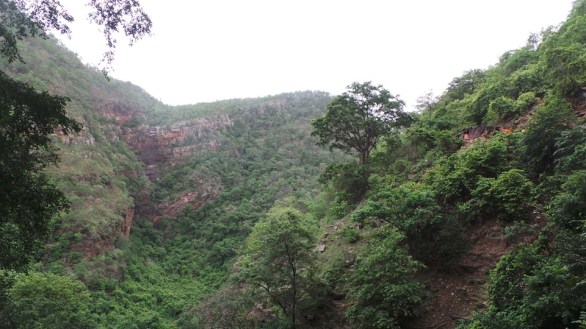
The Eastern Ghats are majorly the result of the volcanic eruptions from the crust of the Earth millions of years ago, and have a complex geology along the places. They are not a continuous range like the Western Ghats but stand out as hillocks or small hill ranges. The disintegration of the Eastern Ghats is believed to be the effect of the East flowing rivers from Western Ghats, cutting them through at places, as they move to the Sea. Eastern Ghats do not stay close to the coast like the Western, but move inside around the Deccan plateau regions, as they move south. The region of Eastern Ghats is majorly taken into consideration by the geologists, based on the rock formation at various places.
The Eastern Ghats starts its presence in Southern Orissa, moving through Vishakapatnam region of Andhra Pradesh, encircling the Godavari and Krishna rivers, move into west AndhraPradesh towards Tirupati, further into Tamilnadu. The Eastern Ghats and the Western Ghats, meet near the Nilgiris, around the Cauvery river basin on the Tamilnadu, Karnataka border, forming a passage of the forest beings moving from the Eastern to the Western Ghats
In the midst of the Eastern Ghats, lies the lush green forest of Nallamalla, in the State of Andhra Pradesh . Nallamalla forest is the longest uninterrupted forest region of the Eastern Ghats, though many such regions exist in the Wastern Ghats. The forest do not attract much human habitation and are seldom cut across by cultivation. This basically has to do much about the formation of this region. The rocks in this region are basically hard rocks of quartzite, with presence of sandstone at few places. These are non porus rocks, and do not allow the rain water to go underground. Water has to flow over the rocks like streams, till they reach the plains. They join the inflow of the rivers flowing from the west. Human habitation is majorly restricted to tribal or forest dwellers in this region, majorly meat gatherers, hunting on the animals dwelling in this region. “Chenchu” group of tribes, is one of the major tribes of this region.
Narasimha Awatar
Lord Vishnu, the preserver of the creation, undertook 9 different incarnations (Avatars) for the protection of the three Worlds. Among the 9 Avatars, the 4th of them was Narasimha Avatar. While in all the other Avatar’s He had assumed the forms beforehand in presence of all Deities, sages, devotees, the same did not happen in Narasimha Avatar. The Avatar was shown only in the last moment. The Lord was very aggressive. The purpose ended as soon as the Lord showed his presence. No one had predicted the form the Lord will take. The aggression was unlimited. It took a long time before He could be calmed down. And Lord was calmed and the peace was restored in all the 3 Worlds
What exactly happened?? Everyone was bewildered. Garuda (The Eagle) was yet to come out of the Surprise. He was the vehicle (Vahana) of the Lord. But He himself could not understand what had happened. He was with the Lord always, at all times, but seriously He couldn’t believe his non-presence during Narasimha Awatar. He tried recollecting the incidents
Hiranyakashipu, the son of Sage Kashyapa, was ruthless. His elder brother, Hiranyaksha was slayed by the Lord, when he hid Bhoomadevi (The Earth) into the Milky Ocean (Milky way- Galaxy as per the scientific terms). Lord Vishnu had assumed the form of Varaha (Boar) and slayed the demon with his tusks, and lifted Bhoodevi with his snout to place Her in the position. Hiranyakshipu was very angry. He decided, he must not meet an end from Lord Vishnu like his brother. He sought sage Narada’s advice. Narada adviced him to pray to Lord Brahma the creator.
Hiranyakshipu , underwent severe penance, disturbing the peace of Gods. Lord Indra, the King of the Gods, was scared of this penance. He decided to imprison Hiryankashipu’s wife, Leelavathi, who was pregnant at that time. As Indra tried abducting her, Sage Narada, stops Him, saves Leelavathi and keeps her in his Ashram. The sage , as part of daily routine, narrated stories on Lord Vishnu, during her stay at the Ashram. . Leelavathi, out of tiredness, slept during these proceedings, but the baby in the womb, was accustomed to listening this. Months later, Leelavathi delivers a boy baby in the Ashrama.
As a result of his penance, Lord Brahma came before Hiranyakashipu. Hiranyakashipu requested for boon that he shouldn’t meet death. But Lord Brahma said that is not possible. Hiranyakashipu requests Lord to grant Him a boon that he would not die from any living being created by Lord Brahma. The death should not be inside his house , or outside, in sky or on ground, not by a human, or an animal, not by any weapon, neither during day time nor during night time”
Lord Brahma grants him the boon. Hiranyakashipu is now the most powerful on Earth. His atrocities continue on Earth (Bhooloka), as well as in Netherworld(Paathalaloka) and the Heaven (Swargaloka). He returns home to find his wife missing. Sage Narada in meantime, assures him that his wife is in his Ashram and son is born. Jubilant Hiranyakashipu, names his son Prahlada and takes them back to palace
The World under the atrocities of Hiranyakashipu, hail him as the supremo. Meanwhile Prahlad grows up , but as a devotee of Lord Vishnu. He believes there is no one more Supreme than Lord Vishnu. Hiranyakshipu enrolls him in Paatashaala (School), but he changes the mind of fellow students as well as teachers. Shocked at his son hailing his enemy, Hiranyakashipu sends him to prison, for loneliness will change his mind. But Lord Vishnu protects him from fear, being with his side as his mother. Angered, he orders the boy be killed- orders snake charmers to set snake on him, mahouts to trample him with elephants, throwing him into the sea, and by seating him in the fire. But the boys’ devotion saves him each time- snakes turn into garlands, elephants worship him, the sea king saves him back and the fire moves away from harming. Disgusted , he orders the boy to drink poison. But the poison turns nectar.
In the end, with a revenge to avenge his enemy, he takes him to the pillared hall of his palace and asks him to show the Lord. Prahlad, undaunted, replies to him that his Lord is everywhere, including a pillar, or a small stick. Angered by his words, Hiranyakshipu raises his mace and tells Prahlad “ Is your Lord in this pillar??”. Prahlad replies “Of course”. Hiranyakshipu says “ Well if so, let me break this. If He comes I will fight Him. If not I will break your head”. Prahlad was undaunted by this. Hiryanyakshipu raises his mace.
Garuda could not recollect event beyond this. What happened after?? All he remembers was Hiranyakashipu lying in a pool of blood, having been slayed. But how?? He had so many boons to protect himself. Where did he go wrong?? How did Lord Vishnu break it out??
Garuda wanted to see the events. He went to the forest (The current region of Nallamalla Forest) and prayed to the Lord. Lord Vishnu arrives and asks Garuda- Garuda you see me everyday but why did you pray for me now? Anything special??. Garuda replied- “Lord, I am not able to understand what happened. How did Narasimha enter. How was he ?? How was Hiranyakashipu killed??. Lord Vishnu smiled – No problem, I will enact it for you in this region itself.
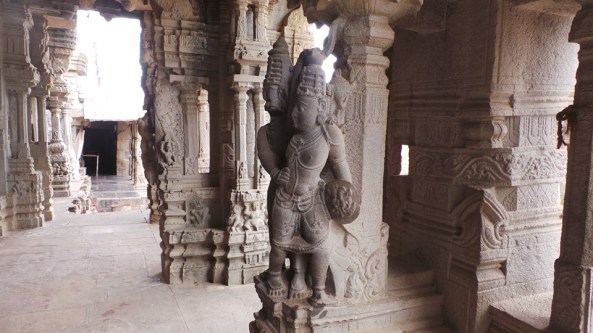
The palace was recreated and the scene began to unfold in front of Garuda’s eyes now. The entire mountain was seen as Hiranyakashipu palace. Hiranyakashipu raises his mace, the pillar is broken. Out of it, emerges Lord Vishnu. He is not in his regular form what Garuda has seen. He is half-lion (Simha) and half-human (Nara). There is aggressiveness in the lion’s face and mightiness in the human body. He looks menacingly at Hiranyakashipu. Hiranyakashipu was perplexed. Who is this?? His Guru Shukracharya arrives- He says , He is Lord Vishnu. Pray to Him and ask for forgiveness. Hiranyakashipu refuses. He raises his mace to attack Him. Lord Narasimha chases Him and catches Him. But Wait. He has got boon from Lord Brahma. That cannot become false.
Recalling the boon, Lord Vishnu says – “ I am not created by Brahma- I am neither Human nor Animal- I am “Narasimha”!!!. He points out- Its neither day time nor night, this is dusk!
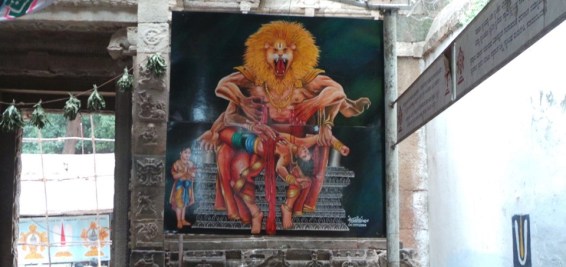
He drags Hiranyakashipu to the doorstep- “You will not be inside the house or outside, you will be on the doorstep. “ He sits down and places him on the lap- “You will neither be in the earth nor in the sky, you will be on my lap and you will be slayed by no weapon or living being, but by my nails, which have no life”. He tears open the abdomen of Hiranyakashipu, killing Him instantly.
But being in the lion form, Lord’s aggressiveness could not be controlled post slaying Hiranyakshipu . The Gods’ turn to Prahlad for the Help. “Prahlad, the Lord has taken this aggressive form for you- only you will be able to calm him down”- Prahlad sings in Lord’s favour and cool him down. Lord then makes Prahlad the King and teaches him the various philosophies and virtues for a Good ruler and good human
Ahobilam (Singavelkundram, as called in Tamil epics , as the Hillock of Lord Narasimha )
The region where this Avatar was repeated by the Lord, lies in vicinity of the Ahobilam town bordering the Nallamala Forest in Kurnool district of Andhra Pradesh . “Aho” stands for Surprise and “Bilam stands for “cave”. Lord Narasimha, showed the complete avatar in the cave to everyone’s surprise. This Town is situated about 25 kms from Allagadda town, and 240 kms from Hyderabad. Nandyal 70 kms away on the Guntakal- Vijayawada section , is the nearest Railway station to this Town. Allagadda is the nearest bus stand, from where Telugu Velugu buses of APSRTC are available at specific timings
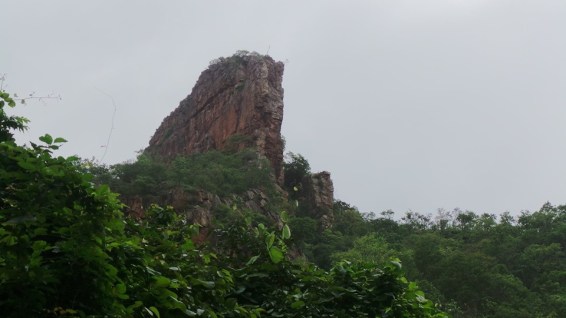
Ahobilam Town , is classified into 2 parts, the Lower and the Upper Ahobilam. The Lower Ahobilam is on a plain, about 17 kms from Allagadda town on Kurnool-Cuddapah Highway. APTDC accommodation by Andhra Pradesh tourism Department , along with various other private guest houses available in this here . Food is generally provided through small family run eateries located in this Town. This is the 1st Town after Allagadda while heading to Ahobilam and the last Town bordering the Nallamalla forest.
Upper Ahobilam , houses the Ugra Narasimha Temple at the base, with few “Annadhaana choultires” (Houses providing free food) and very few accommodations. APSRTC buses from Allagadda ply till this temple, located 8 kms away from Lower Ahobilam
The place where this Avatar was re-enacted, are depicted in various temples, in the forests of Nallamalla. The complete forest in Ahobilam is believed to be the palace where the avatar was re-shown to Garuda . The below are the important places in the forest region adjoining the town
1. Ugra Stambha- The pillar of anger. The pillar from which the Lord emerged. This pillar is on the hill peak in the forest area. The pillar is still said to be hot, out of the anger of the Lord . There is a huge rock protruding out of the Earth at this point. The rock, is a formation of Eastern Ghats and seems to be a result of the volcanic activity .
This place can be reached only through trek through deep Nallamalla forest from the Upper Ahobilam Temple, and takes about 5 hrs by walk . Jwala Narasimha Temple is on the way to Ugra Stambha
PS: The walk is through a complete rugged terrain and is recommended for people within the age group of 25- 35 years with a local guide
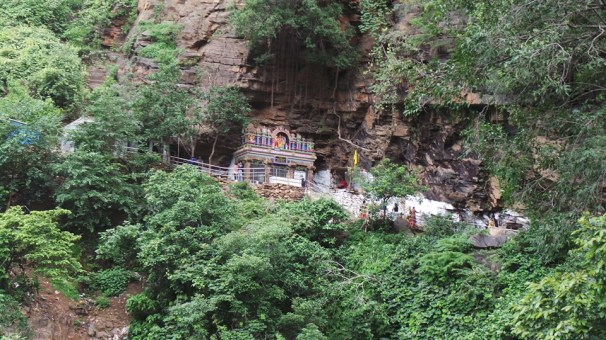
2. Jwala Narasimha Temple- The Lord is still Aggressive here , the idol inside a natural cave. The idol is naturally formed and is believed to be hot, with the Lord still burning in anger. The idol, a natural formation seems to be a resultant of volcanic activity in this region, likely retaining the heat . Sculptures of Hiranyakashipu, Prahlad, Shukracharya are standing and worshipping the Lord next to him. Lord Narasimha has Hiranyakashipu on the lap at this Temple, in the process of slaying Him. This is believed to be the doorstep of the palace where Hiranyakshipu was slayed .
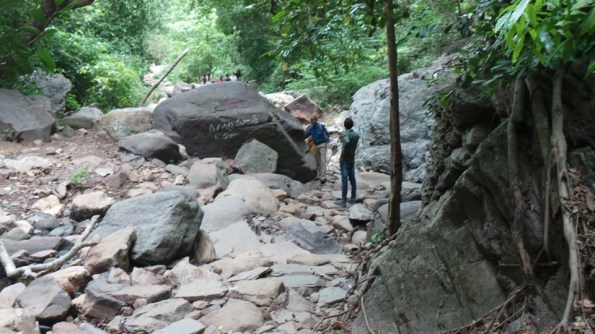
All deities present at time of the slaying of Hiranyakshipu have believed to have recited the Narasimha stotram , to pacify the Lord at this place.
“Ugram Veeram Maha Vishnum Jvalantam Sarvato MukhamNrusimham Bheeshanam Bhadram Mrutyur Mrutyum Namahyaham”
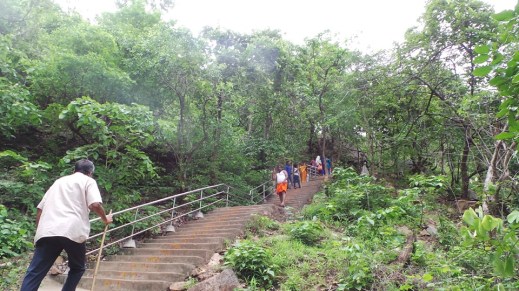
This place can be reached only through trek through Nallamalla Forest from Upper Ahobilam Temple for a distance of 3 kms uphill.(About 2 hrs) Doli services available at cost of Rs. 3000/- per person. Guide recommended for 1st timers at a cost of Rs. 2000/- per person. Support sticks are available for rent at Rs.3/- per stick near the Upper Ahobilam Temple
PS: Panagam (Jaggery water) is provided here by local people, in front of the Temple. Provides a much needed refreshment, once the walk is completed and provides the much needed energy for the return walk
2a. Aakashaganga Falls– A huge stream of water, falls off the rocks, just before the Jwala Narasimha Temple. This is believed to be the water of Ganga, coming down to Earth to cool the Lord. As mentioned earlier, the quartzite rock do not absorb water, but let it flow out, resulting in a waterfall direct to the nallamalla forest. The thick forest do not disclose the area where the water finally lands
2b. Raktha Kundam– A small pool of water, near the temple. The water is slightly red in colour, owing to Lord washing his hands in the same, after slaying the demon. Again, volcanic activity have resulted in different rocks in this region, adding a slight colour to the water
2c. Garudadri hill– The hill on opposite to Jwala Narasimha Temple, in shape of Garuda . Believed to be the place where Lord was worshipped.
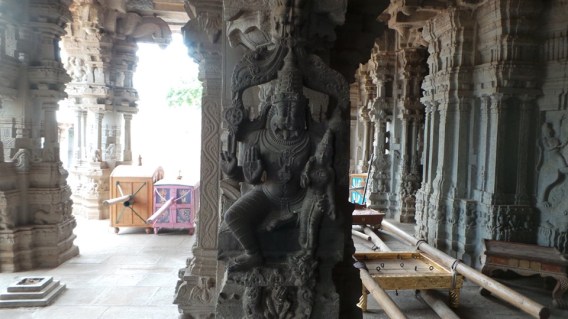
3. Kroda Narasimha & Bhoo-Varahaswamy – Normally mentioned as Varaha Narasimha Swamy Temple, the temple has naturally formed idols of Varahaswamy and Narasimha still in anger mode. The sculptures are also inside the cave over which the temple has been built. The main mantapa of the temple is believed to be built in vijayanagar era, with some sculptures around giving the impression
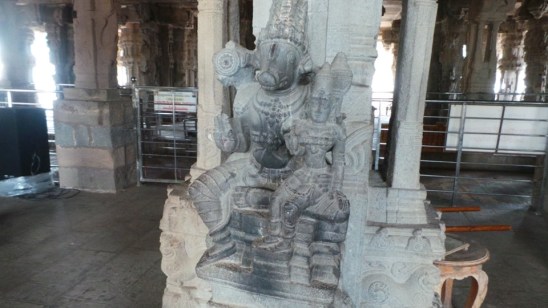
Unlike avatars of Shri Rama and shri Krishna, where the demon brothers were slayed by the single avatar, the brothers Hiranyaksha and Hiranyakashipu were slayed by Lord in 2 Awatars in this temple. Lord Vishnu is hence seen in both the awatars at this place, indicating the complete story. The idol inside the temple has Bhoodevi on the snout of Varaha
This Temple can be reached through trek from Upper Ahobilam Temple for a distance of 1km.(15 mins) This Temple is on the way to Jwala and Malola Narasimha Temples
3a. Ramanuja Mantapa– A small elevated structure near the Krodha Narasimha swamy Temple, where Shri Ramanujar was said to have performed meditation to Lord Narasimha, during his course of journey across the Country
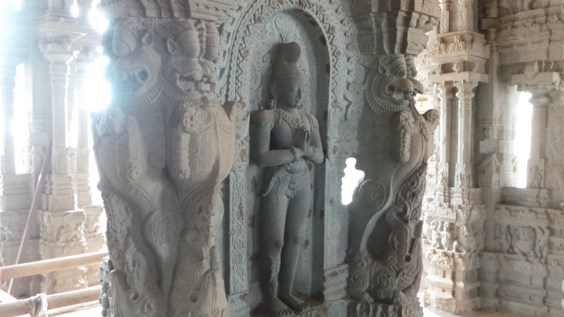
3b. Dhyana mantapa– A pillared hall, built in the vijayanagar era is situated enroute to the Kroda Narasimha Swamy Temple. This hall is generally used by devotees and sages for meditating , absorbing the calmness of the Nallamalla forest.
4. Mallola Narasimha Temple– Lord Narasimha is called “Maa-Lola” or beloved of the Mother Goddess Lakshmi. Goddess Lakshmi is seen on the lap of Lord Narasimha in this Temple . Post being calmed down by Prahladha, Lord Narasimha gives a darshan to all the deities along with Goddess Lakshmi.
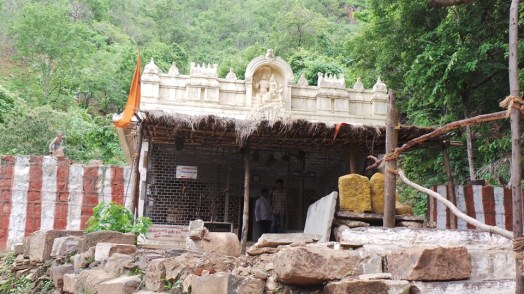
This Temple can be reached by trek from Upper Ahobilam Temple. This Temple is located at about 1 km from Kroda Narasimha Temple, but on opposite direction to Jwala Narasimha
4a Prahlad Basidi or the School of Prahlad is located ½ a kilometer away from this temple, but through a rugged terrain.
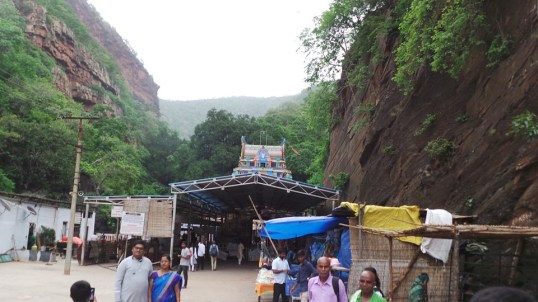
5.Ugra Narasimha Temple- This Temple, forms the base temple at the Town of Ahobilam (Upper). Lord Narasimha is seen in a cave inside this Temple . There is also a statue of Shiva Linga , doing the pooja to pacify the Lord at this Temple. The Lord is still in his angry form at this Temple .
6. Yogananda Narasimha Temple– This Temple is located the town of Ahobilam (Lower). This Temple was where Lord Narasimha preached all the righteousness of a Ruler and a Human Being to Prahlad, after being crowd the King. This Temple also has a small teshrine dedicated to all 9 forms of Lord Narasimha, a summary of all the Temples located at Ahobilam. This Temple is accessible by car and is situated near Lower Ahobilam
While the above places, , form the base of the story of Lord Narasimha , the below places, have their own stories linked to Lord Narasimha of Nallamala forest
1. Karanje Narasimha Temple- Once, Lord Hanuman, undertook severe meditation in Nallamalla forest , in devotion to Lord Rama (It may be noted that the Hanuman birthplace of Kishkintha is located close to Hampi, hardly 200 kms away by road ). But Nallamalla forest was in control of Lord Narasimha, and hence, Lord Vishnu decided to bless his devotee in Narasimha Avatar. Lord hanuman was not happy seeing Narasimha. Lord Hanuman chided Lord Narasimha for coming in such an aggressive form, unlike the peaceful , smiling form of Lord Rama. Hanuman couldn’t accept Lord Rama and Lord Narasimha both were incarnations of Lord Vishnu and are one and the same . To prove Lord Narasimha stood there with the “Shiva Dhanush” bow of Lord Rama and convinced Lord Hanuman. The Temple is situated under “Karanje Tree” and hence, the Lord is named Karanje Narasimha
This Temple is located between Upper and Lower Ahobilam Temple and can be accessed through vehicles
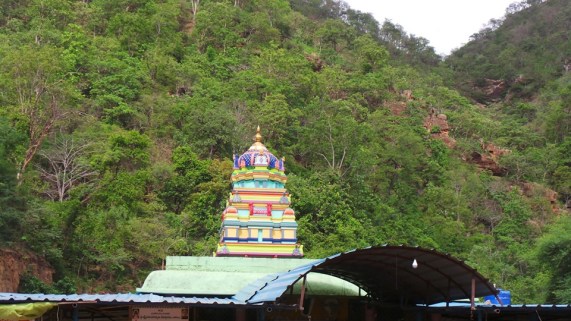
2. Pavana Narasimha- Lord Narasimha was very aggressive. Everyone was scared of Him, including Gods, Sages and other deities. The “chenchu tribals” of Nallamalla forest were scared to the extent and ran helter-skelter. All , except a beautiful Chenchu lady. Goddess Lakshmi, realizing Lord Vishnu going to Earth, gave her incarnation as a beautiful tribal girl Chenchu Lakshmi , and awaited for God to come down. Chenchu Lakshmi was impressed by beauty of Lord Narasimha, and Lord Narasimha was impressed by the brave girl, who refused to run seeing the Lord. Lord Narasimha took Chenchu Lakshmi as His consort and settled in the forest.
Lord Narasimha, being very fond of Chenchu Lakshmi for having chosen him in this aggressive state, went for hunting and returned with meat for Her. Chenchu Lakshmi was deeply pleased by the care taken by Lord Narasimha
But the tribals felt that the Lord must not be hunting for the meat, just because of marrying a tribeswomen. Hence, they offered to provide meat once a week to Chenchu Lakshmi such that the Lord need not undergo this severe job of hunting . Lord Narasimha , chose Saturday for the same, as it’s a special day for Lord Vishnu . The tribes local tribes still perform animal sacrifices at this Temple, every Saturday as an offering to Chenchu Lakshmi at this stemple
This Temple is located at about 24 kms from Lower Ahobilam temple, but inside the forest. Can be accessed by walk (7 kms- 3 hrs) , or through local jeep rides only(1.25 hrs). This Temple can also be walked from Upper Ahobilam Temple at a distance of 5 kms (Tough terrain).
PS:The jeep ride is not recommended in a post lunch session
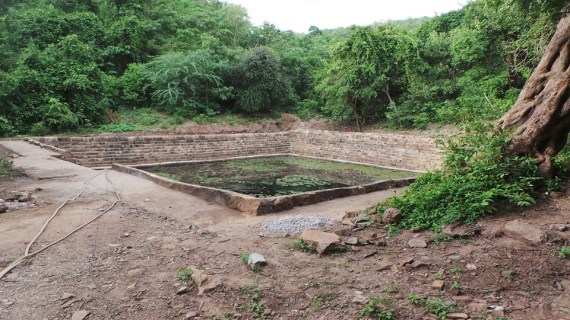
3. Bhargava Narasimha- Parasurama or Shri Bhargava Rama, underwent penance here, wishing to see their Narasimha Avatar, along with all the 9 awatars of the God. Lord Narasimha, showed his Angry form or Ugra Narasimha here, and the 9 awatars, depicted around on a arch around the idol of Lord Narasimha in the Temple. There is tank at the base of the Temple, constantly fed by stream out of rain water, sprouting under the ground.
This Temple is located about 4 kms from Lower Ahobilam Temple, and can be reached by walk or jeeps. Jeeps charge Rs. 3000/- for covering Bhargava and Pavana Narasimha Temples.
4. Chatravaka Narasimha – While Lord Narasimha was in his anger at Nallamalla, 2 Gandharvas or celestial deities, Aaha & Oho , presiding in the Nallamalla Forest , in a joyous mood , were singing songs in course of their work. Lord Narasimha was moved by the songs , bent down to listen to them. He could not stop tapping his hand , for the song, so He sat down and started tapping for the song on his lap, while the Gandharvas song. The anger slowly turned into a smile. The Lord at this Temple is popular as “Sangeethapriya Narasimha” and one of the few places where Lord is in full smiles
This Temple is located about 1 km from the Lower Ahobilam Temple and can be accessed by car. It is on the way to Yogananda Narasimha Temple.
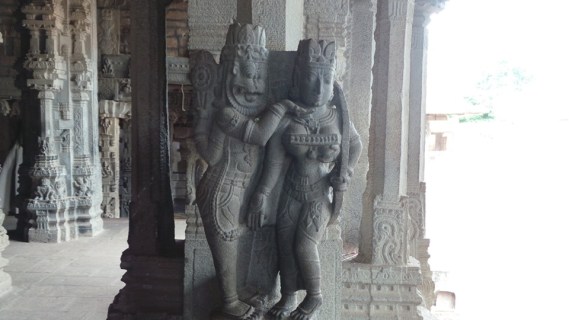
5. Ahobilam Narasimha Temple- The Temple at Ahobilam (Lower), which is for the main administration purpose. Lord Narasimha & Chenchu Lakshmi are main deities at this Temple. This Temple is under the administration of Ahobilam Mutt
As per History, in the 16th Century, the entire country was majorly under the rule of Non-Hindu rulers. And one of the rulers bought Ahobilam under his siege. The priest residing at this Temple, fearing the destruction, communicated it to the Vijayanagar dynasty. The Vijayanagar ruler, then bought the same under his control and developed the Temple in the Vijayanagar style, safeguarding it completely, and sculpturing it according to Shri Narasimha Mythology. Sculptures of Lord Narasimha, Goddess Chenchu Lakshmi , Shri Varaha Swamy can be seen in the mantapa developed by Vijayanagar Empire. The Temple Gopuram, entrance as well as a pillared hall were constructed around the Temple, during the visit by the Vijayanagar King
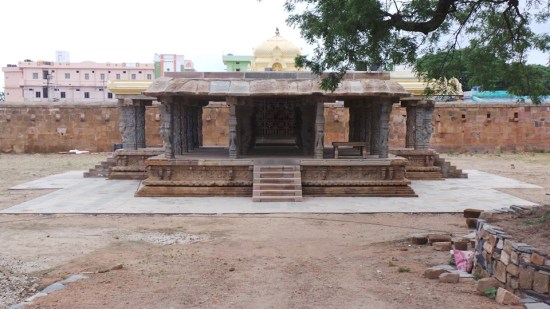
A visit to Ahobilam , is overall , not only for the people undergoing pilgrimage, but for nature, trek, photographic, historic, geographic, geologic enthusiasts as well. A visit to the region gives a much required relaxation from the stress of the everyday run and a much required positive energy to move on in life.
Thank you for reading!!!!

 South India- The Splendour!!